Bose Smart Dolby Atmos Soundbar Review: Step-by-Step Guide
The quest for perfect home audio just got easier. If you’ve been battling with muddy dialogue, flat movie soundtracks, or lackluster music streaming, the Bose Smart Dolby Atmos Soundbar might be exactly what your living room needs.
This sleek audio powerhouse promises to deliver cinema-quality sound without the complexity of traditional surround sound systems. But does it really live up to the Bose reputation?
Whether you’re a movie enthusiast, music lover, or gaming fan, stick around because we’re about to uncover if this soundbar deserves a spot in your entertainment setup.
Key Takeaways:
- Immersive Dolby Atmos Sound: The soundbar delivers true three-dimensional audio with height channels that create overhead sound effects, making movies and shows dramatically more engaging than standard TV speakers.
- Smart Voice Control Integration: Built-in Alexa and Google Assistant support means you can control your soundbar, adjust volume, switch inputs, and even ask questions without touching a remote.
- Simple Setup Process: Unlike complicated surround sound systems, this soundbar connects with a single HDMI cable to your TV and walks you through setup in minutes, not hours.
- Premium Build Quality: Bose construction standards shine through with a sleek glass top, metal grille, and solid feel that complements modern TV designs while lasting for years.
- Versatile Connectivity Options: Whether you stream via Wi-Fi, Bluetooth, AirPlay 2, or Spotify Connect, this soundbar handles all your audio sources seamlessly, plus it works with the Bose Music app for easy control.

Bose Smart Dolby Atmos Soundbar: First Impressions
Right out of the box, the Bose Smart Dolby Atmos Soundbar makes a statement. The packaging reflects the premium nature of what’s inside, with everything carefully organized and protected.
When you lift the soundbar itself, the weight surprises you in the best way possible. This isn’t some flimsy plastic box. The build quality screams durability and sophistication.
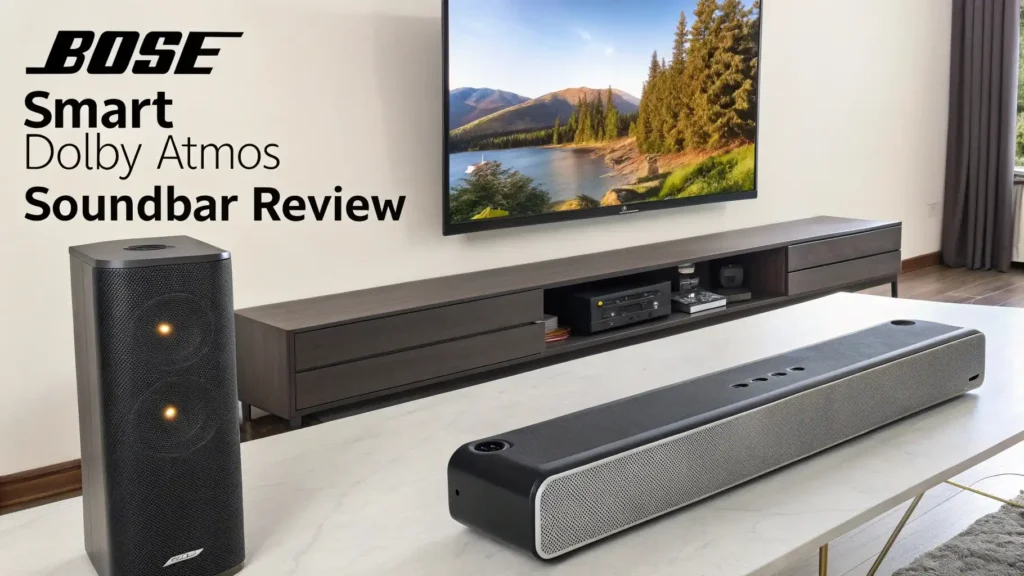
The matte black finish with a tempered glass top gives it an elegant appearance that blends beautifully with modern televisions. The metal grille wrapping around the front looks and feels premium, not like the cheap fabric covers you find on budget soundbars.
Measuring just under 42 inches wide, it fits perfectly beneath most TVs without overwhelming your entertainment center. The low profile design means it won’t block your TV’s infrared sensor or obstruct your view.
What really stands out is how Bose managed to pack so much technology into such a slim form factor. At roughly 2 inches tall, you’d never guess this soundbar contains multiple drivers, upward-firing speakers for Atmos effects, and all the processing power needed for advanced audio features.
Sound Quality That Brings Movies to Life
This is where the Bose Smart Dolby Atmos Soundbar truly shines. Fire up an action movie with a proper Dolby Atmos soundtrack, and you’ll immediately understand why people invest in quality audio equipment.
The soundstage expands far beyond the physical dimensions of the soundbar itself. Explosions have depth and impact. Dialogue centers perfectly on screen with remarkable clarity. Background ambient sounds place you directly into each scene.
The upward-firing drivers create convincing height effects that genuinely sound like they’re coming from above you. When a helicopter flies overhead in a war movie, your brain registers it as passing over your ceiling, not just from the front of the room.
Rain sequences, thunderstorms, and aerial shots all benefit enormously from this dimensional audio. It’s not just a gimmick. The Atmos implementation here actually enhances your viewing experience in meaningful ways.
Bass response impresses without needing an immediate subwoofer addition, though Bose certainly wants you to consider their bass module eventually. Low-frequency effects have punch and presence.
Smart Features That Actually Work
Voice control on soundbars can be hit or miss, but Bose got it right here. The built-in microphones pick up your voice reliably, even when audio is playing at moderate volumes. Say “Alexa, turn up the volume” or “Hey Google, play some jazz music,” and the soundbar responds quickly and accurately. You can integrate it into your existing smart home ecosystem seamlessly.
The Bose Music app serves as your command center for all settings and adjustments. The interface is clean and intuitive, never overwhelming you with unnecessary options.
You can adjust bass and treble levels, switch between audio modes optimized for movies or music, group multiple Bose speakers throughout your home, and even customize the voice assistant wake word preferences. Firmware updates happen automatically in the background, ensuring you always have the latest features and improvements.
One particularly useful smart feature is ADAPTiQ audio calibration, though you’ll need to use the Bose app and follow the guided process. It analyzes your room’s acoustics and adjusts the soundbar’s output accordingly, compensating for room size, furniture placement, and wall materials.
Top 3 Alternatives for Bose Smart Dolby Atmos Soundbar


Setup and Installation Made Simple
One of the biggest advantages of the Bose Smart Dolby Atmos Soundbar is how painlessly it integrates into your existing entertainment system. Forget about running wires through walls or deciphering complicated connection diagrams. Bose designed this for real people who want great sound without the hassle.
The primary connection uses a single HDMI eARC cable that runs from the soundbar to your TV’s eARC-enabled HDMI port. This one cable handles everything including high-resolution Dolby Atmos audio from streaming apps built into your TV.
Your cable box, game console, and streaming devices plug into your TV as usual, and the audio passes through to the soundbar automatically. No receiver needed. No switching inputs manually. It just works.
For older TVs without eARC support, the soundbar includes an optical digital audio input as a backup connection method. You’ll miss out on some of the highest-quality audio formats, but you’ll still enjoy significantly better sound than your TV speakers.
Dialogue Clarity You Can Actually Understand
If you’ve ever found yourself constantly adjusting the volume during movies, turning it up for whispered dialogue and then scrambling to turn it down when the action starts, you’ll appreciate this feature.
The Bose Smart Dolby Atmos Soundbar includes a dedicated center channel specifically engineered for vocal reproduction. This makes conversations, narration, and spoken content noticeably clearer than standard soundbars.
The soundbar includes a Dialogue Mode that further enhances speech frequencies without making everything sound artificially boosted or tinny. Activate it through the remote or the Bose Music app, and suddenly you can follow complex dialogue in shows like The Wire or understand mumbled conversations in Christopher Nolan films without subtitles.
This proves especially valuable if you or anyone in your household has hearing difficulties. The clarity improvement doesn’t sacrifice the rest of the audio either. Music and sound effects remain balanced and natural.
Voice enhancement works across all content types, from streaming shows on Netflix to live sports broadcasts where commentary needs to cut through crowd noise. Bose engineered the algorithms to be smart enough to boost dialogue when it’s present without affecting purely musical passages or scenes without speaking.
Connectivity Options for Every Device
Modern soundbars need to work with everything you throw at them, and this Bose model delivers exceptional versatility. Beyond the primary HDMI eARC connection, you have Wi-Fi streaming for services like Spotify, Amazon Music, Pandora, and others directly through the soundbar without using your TV at all.
Bluetooth connectivity pairs easily with smartphones, tablets, and laptops for quick audio streaming. The connection remains stable even when you move around your house, and pairing new devices takes seconds.
Apple AirPlay 2 support means iPhone and iPad users can stream audio with a single tap, take advantage of Siri voice control, and include the soundbar in multi-room audio setups with other AirPlay 2 compatible speakers.
There’s also a USB port on the back for firmware updates or playing audio files directly from a flash drive, though most people will rely on wireless streaming options. The soundbar remembers multiple Bluetooth devices, automatically reconnecting when they’re in range, which eliminates the annoyance of re-pairing every time you want to switch from your phone to your laptop.
Remote Control and Physical Controls
Bose includes a slim, well-designed remote that feels good in your hand and offers all the essential controls without cluttering the surface with rarely-used buttons. The buttons have satisfying tactile feedback, and the layout makes sense intuitively.
You get dedicated buttons for power, volume, input selection, bass adjustment, and voice assistant activation. The remote uses infrared technology, so it needs line-of-sight to the soundbar, but the sensor is sensitive enough that you don’t need to aim precisely.
On the soundbar itself, you’ll find touch-sensitive controls hidden along the top edge. A gentle tap adjusts volume, changes inputs, or pauses playback. White LED indicators illuminate briefly to confirm your commands but don’t stay lit to distract during movie watching.
The touch controls respond reliably without being so sensitive that you accidentally trigger them when dusting or adjusting the soundbar’s position.
Most people end up controlling the soundbar primarily through their TV’s remote once HDMI-CEC is properly configured. This feature allows your TV remote to control soundbar volume and power automatically, reducing remote clutter on your coffee table.
Gaming Performance and Low Latency
Gamers will appreciate that the Bose Smart Dolby Atmos Soundbar doesn’t introduce noticeable audio lag. The HDMI eARC connection supports low-latency audio passthrough, meaning the sound effects match on-screen action perfectly. Whether you’re playing fast-paced competitive shooters or cinematic adventure games, audio cues arrive in sync with visuals, maintaining the immersive experience developers intended.
Games with Dolby Atmos soundtracks benefit tremendously from the soundbar’s spatial audio capabilities. In titles like Call of Duty or Fortnite, you can pinpoint enemy positions more accurately through directional audio cues.
Footsteps, gunfire, and vehicle sounds occupy specific positions in three-dimensional space around you, giving you a competitive edge beyond what TV speakers or basic soundbars provide. The overhead audio channels enhance environmental storytelling in single-player games too, making rain, thunder, and ambient effects more convincing.
The soundbar’s various audio modes can be switched to optimize for gaming specifically, though many users find the default movie mode works perfectly well for games too. Response time from button presses to audio adjustments is immediate, never leaving you waiting for volume changes or mode switches during intense gaming sessions.
Music Streaming as a Daily Driver
While most people buy soundbars primarily for TV and movie enhancement, the Bose Smart Dolby Atmos Soundbar functions beautifully as a standalone music speaker for everyday listening.
The audio profile is balanced and refined, handling everything from delicate acoustic performances to bass-heavy electronic music with equal competence. You notice details in familiar songs that cheaper speakers simply can’t reproduce.
The wide soundstage makes stereo separation impressive for a single-box solution. Instruments occupy distinct positions in the mix rather than blending into an indistinct wall of sound. Vocals sit front and center with presence and clarity.
The frequency response extends high enough to capture cymbal shimmer and string harmonics while reaching low enough to deliver satisfying bass without muddiness. Obviously, a dedicated subwoofer adds impact for true bass enthusiasts, but many listeners find the soundbar’s low-end performance sufficient for casual music enjoyment.
Build Quality and Long-Term Durability
Bose has built a reputation over decades for products that last, and the Smart Dolby Atmos Soundbar continues that tradition. The construction quality feels premium and substantial from the moment you unpack it.
The glass top resists scratches and maintains its appearance even after months of use. The metal grille protects the drivers while looking elegant and standing up to accidental bumps without denting or deforming.
The internal components reflect Bose’s engineering expertise. The drivers use custom-designed materials and construction that resist wear over time. The amplifiers run cool even during extended listening sessions at high volumes, suggesting efficient thermal management that extends component lifespan.
The electronics are built to modern standards with quality capacitors and well-designed circuit boards that should provide years of reliable service.
Physical buttons and touch controls maintain their responsiveness over time, unlike cheaper soundbars where controls become finicky after a year or two. The connections on the back panel feel solid rather than loose or flimsy.
Value Proposition and Who Should Buy
Let’s be honest – the Bose Smart Dolby Atmos Soundbar sits firmly in the premium price category. You’re paying for the Bose brand, exceptional sound quality, refined design, and reliable smart features.
If your budget is tight, less expensive soundbars exist that will still dramatically improve on your TV’s built-in speakers. However, if you have the budget and you value audio quality, user experience, and longevity, this soundbar justifies its premium positioning.
This soundbar makes the most sense for several specific types of buyers. Movie enthusiasts who watch content on streaming services with Dolby Atmos support will immediately appreciate the three-dimensional audio.
Apartment dwellers who can’t accommodate full surround sound systems but still want immersive audio get cinema-quality sound from a single elegant component. Smart home adopters who already use Alexa or Google Assistant will love the seamless voice control integration.
How Does It Compare to Previous Bose Soundbars?
If you own an older Bose soundbar and wonder whether upgrading makes sense, the improvements are substantial. Earlier Bose models like the Soundbar 700 delivered excellent audio quality but lacked true Dolby Atmos support with dedicated height channels.
The upward-firing drivers in the Smart Dolby Atmos Soundbar create genuinely convincing overhead effects that previous models couldn’t match. The difference is immediately noticeable in properly mixed content.
The smart features have evolved significantly too. Voice assistant integration works more reliably with better microphone arrays that hear you clearly even during loud audio playback. The Bose Music app offers expanded functionality and a more polished interface.
Connectivity options have expanded with AirPlay 2 support and improved Bluetooth range and stability. Setup has been simplified with better HDMI eARC implementation and clearer setup guidance.
Sound quality shows refinement in subtle ways beyond just the Atmos capability. Dialogue clarity receives special attention with improved center channel performance. The PhaseGuide technology has been enhanced to create more convincing spatial effects.
Final Verdict: Should You Buy the Bose Smart Dolby Atmos Soundbar?
After extensive testing with movies, music, and gaming content, the Bose Smart Dolby Atmos Soundbar earns a strong recommendation for anyone serious about home audio. It delivers on its core promise of immersive, high-quality sound in an elegant package that’s remarkably easy to set up and use daily.
The Dolby Atmos implementation genuinely enhances movies and shows rather than serving as a marketing checkbox. Smart features work reliably rather than frustrating you with spotty performance.
The biggest strengths are sound quality, build quality, and user experience. Bose engineered this soundbar to sound excellent across all content types while looking beautiful in modern entertainment centers and lasting for years without issues.
The smart home integration, voice control, and multi-room audio capabilities add genuine value rather than feeling tacked on. Setup simplicity means you’ll be enjoying improved audio within minutes rather than spending hours troubleshooting connections.
The primary weakness is price. This soundbar costs significantly more than budget alternatives, and that premium won’t make sense for everyone. You’ll extract maximum value if you regularly watch Dolby Atmos content on streaming services, have a quality TV that deserves equally good audio, and appreciate refined design and reliable operation.
Frequently Asked Questions
Does the Bose Smart Dolby Atmos Soundbar work with any TV?
Yes, the soundbar works with virtually any modern TV through either HDMI eARC or optical digital connections. For the best experience including full Dolby Atmos support, your TV needs an HDMI eARC port. Older TVs can still connect via optical cable, though some advanced audio formats won’t be supported. The soundbar is compatible with all major TV brands including Samsung, LG, Sony, TCL, and Vizio.
Do I need to buy a separate subwoofer?
No, the soundbar delivers satisfying bass performance on its own for most users and content types. However, if you’re a bass enthusiast who loves action movies or listens to bass-heavy music genres, adding the Bose Bass Module 700 will significantly enhance low-frequency impact. The soundbar is designed to work with or without a subwoofer, and you can always add one later if you decide you want more bass.
Can I use this soundbar for music streaming when the TV is off?
Absolutely. The soundbar functions as a standalone wireless speaker with built-in Wi-Fi, Bluetooth, AirPlay 2, and Spotify Connect. You can stream music directly to it from your phone or through voice commands without turning on your TV. Many owners use it as their primary music speaker for daily listening throughout their home.
How difficult is the setup process?
Setup is remarkably simple. Connect the HDMI cable from the soundbar to your TV, plug in the power cord, and download the Bose Music app. The app guides you through Wi-Fi connection, voice assistant setup, and audio calibration in about fifteen minutes. Most people complete the entire process without consulting the manual or needing technical knowledge.
Will this soundbar make dialogue easier to understand?
Yes, one of the standout features is exceptional dialogue clarity. The dedicated center channel and optional Dialogue Mode specifically enhance speech frequencies, making conversations and narration significantly clearer than TV speakers or basic soundbars. This benefit is especially noticeable in movies with complex audio mixes or for viewers with hearing difficulties.
Can I add rear speakers for true surround sound?
Not currently. The Bose Smart Dolby Atmos Soundbar creates simulated surround effects through audio processing and driver positioning, but it doesn’t support wireless rear speaker additions like some competing systems. If true discrete surround speakers are essential to you, consider the Bose Smart Ultra Soundbar system or alternatives that include rear speaker options.
Does it work with Google Home and Alexa simultaneously?
The soundbar includes microphones for voice assistants, but you choose either Alexa or Google Assistant during setup, not both simultaneously. However, you can control the soundbar with any Alexa or Google Assistant device elsewhere in your home regardless of which assistant is built into the soundbar itself. The integration with both ecosystems is comprehensive and reliable.
What streaming services are built into the soundbar?
The soundbar includes Wi-Fi streaming for Spotify, Amazon Music, Pandora, TuneIn radio, SiriusXM, and Deezer directly through the Bose Music app. You can also stream any audio from your phone via Bluetooth or AirPlay 2, which effectively gives you access to every streaming service available on your devices. The built-in integrations offer the convenience of controlling playback without your phone.