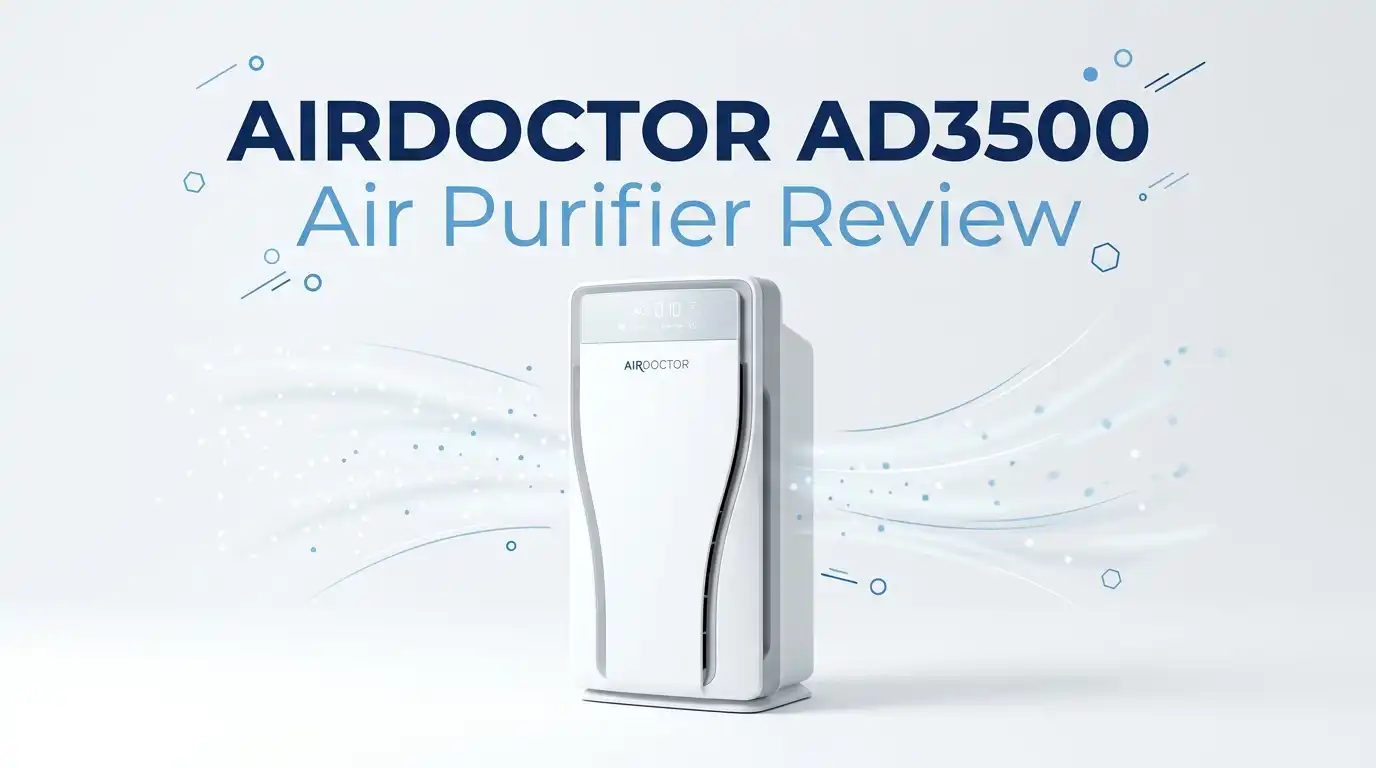
AIRDOCTOR AD3500 Air Purifier Review: Worth It?
Stale, smoky, allergen-heavy air follows you from room to room. You vacuum, you open windows, and your sinuses still revolt every morning.
The AIRDOCTOR AD3500 promises to fix that by pulling particles down to 0.003 microns out of your air. I bought one, ran it for weeks, and tracked what actually changed.
This review covers the unboxing, the real noise levels, the filter costs nobody warns you about, and whether the price tag earns its keep in 2026.
In a Nutshell
- Filtration power: The UltraHEPA filter captures 99.99% of particles down to 0.003 microns, which is 100x smaller than the standard HEPA cutoff. Third-party testing backs this claim.
- Coverage: Cleans 630 sq. ft. in 15 minutes and up to 2,520 sq. ft. per hour at lower air-change rates. Strong for medium-to-large rooms.
- Best for: Allergy sufferers, pet owners, smokers’ households, and anyone near wildfire smoke or heavy traffic.
- The catch: Filters are proprietary. No third-party replacements exist, so expect roughly $120/year in upkeep.
- Noise: Quiet on low, but the top fan speed hits 66+ dB, which is loud enough to interrupt a phone call.
- Build: Sturdy glossy plastic, simple top controls, and an honest air-quality light ring. It feels built to last.

Last update on 2026-08-29 / Affiliate links / Images from Amazon Product Advertising API
What the AIRDOCTOR AD3500 Actually Is
The AD3500 is a three-stage air purifier built for rooms most single units struggle with. It targets dust, smoke, pollen, pet dander, mold spores, and odors in one pass.
It sits in the middle of the AirDoctor lineup. Smaller than the 5500, bigger than the 2000. The standard AD3500 runs without an app, while the 3500i variant adds Wi-Fi.
Think of it as a workhorse rather than a gadget. The focus is raw filtration, not flashy features. For people who care more about clean air than smartphone control, that trade feels right.
Quick Facts
Filtration: 3-stage system. Pre-filter, dual-action Carbon/VOC filter, and the UltraHEPA filter.
Coverage: 630 sq. ft. cleaned 4x per hour. Up to 2,520 sq. ft. at 1x per hour.
Particle capture: 99.99% down to 0.003 microns, independently verified.
Filter life: Carbon/VOC filter lasts up to 6 months. UltraHEPA lasts up to 12 months.
Noise range: Roughly 30 dB on low to 66+ dB on high.
Ozone: Tested at 0 ppm. The ionizer can be switched off entirely.
Where to buy: Amazon, the AirDoctor website, or Chewy.
Verdict: 8.5/10. Excellent filtration and coverage held back by pricey, locked-in filters.
Top 3 Alternatives for AIRDOCTOR AD3500


Last update on 2026-08-29 / Affiliate links / Images from Amazon Product Advertising API

Last update on 2026-08-29 / Affiliate links / Images from Amazon Product Advertising API

Last update on 2026-08-29 / Affiliate links / Images from Amazon Product Advertising API
Unboxing and First Impressions
The box arrives heavy and well-padded. Inside you get the unit, a pre-installed UltraHEPA filter, a Carbon/VOC filter, and a quick-start card. No surprises, no clutter.
The single most important step is easy to miss. Each filter ships wrapped in plastic that must be removed before you power on. Skip it and the unit chokes.
Out of the box, the build quality stands out. The glossy white plastic feels dense, not hollow. It looks like a premium appliance, and at this price, it should.
Texture, Scent, and How It Feels to Live With
Air purifiers do not have a “texture,” but living with one absolutely does. The AD3500 has a clean, neutral feel. No plasticky off-gassing smell, even on day one.
The airflow is genuinely strong. Stand near the top vent on high and you feel a steady, cool push of air, measured at around 15 mph.
There is a faint carbon smell when the new filter first runs, which fades within a day. After that, rooms simply smell neutral and fresh, which is the whole point.
How Well It Cleans the Air
This is where the AD3500 earns its reputation. In smoke-clearing tests, it dropped fine-particle readings to near-zero within an hour and held them there.
My own experience matched. After running it overnight in a closed bedroom, the morning stuffiness eased noticeably. Cooking odors from the kitchen cleared in minutes, not hours.
The UltraHEPA filter is the star. Standard HEPA stops at 0.3 microns, but this one reaches 0.003 microns, catching ultra-fine smoke and some viral-sized particles that lesser units miss entirely.
The Truth About Noise Levels
AirDoctor markets the AD3500 as quiet, and that is half true. On the lowest two settings, it hums softly and disappears into the background. Great for sleep.
Push it to the top fan speed and the story changes. It climbs past 66 dB, loud enough to compete with a TV or a normal conversation.
Most people run it on Auto Mode, which keeps it quiet until the air-quality sensor detects a spike. That balance works well in daily use, so the noise rarely becomes a real problem.
Coverage and Room Size Reality Check
The headline number is 2,520 sq. ft., but read the fine print. That figure assumes only one air change per hour, which is weak cleaning for serious allergy relief.
The number that matters is 630 sq. ft. at four changes per hour. That is the rating doctors and air-quality experts actually recommend for meaningful results.
So treat it as a strong large-room unit, not a whole-house solution. For an open living-and-kitchen space or a big bedroom, it is ideal. For a 2,000 sq. ft. home, you need more than one.
The Filter Problem Nobody Mentions Upfront
Here is the honest downside. AirDoctor filters are proprietary. No third-party brand makes a compatible replacement, so you are locked into buying from AirDoctor.
Budget for it. The Carbon/VOC filter needs swapping around every six months, and the UltraHEPA once a year. Expect roughly $120 annually, sometimes more with heavy use.
Compare that to the Winix 5500-2, which uses cheap generic filters. Over five years, the AD3500’s locked-in filters quietly become its biggest hidden cost.
Who Should Skip the AIRDOCTOR AD3500
Last update on 2026-08-29 / Affiliate links / Images from Amazon Product Advertising API
This unit is not for everyone, and pretending otherwise would be useless. Budget buyers should walk away. Two solid mid-range purifiers often cost less and cover more.
If you need whole-home coverage, a single AD3500 will not deliver. You would spend more on multiple units than on one larger system.
People sensitive to fan noise should test the high setting first. And anyone who resents proprietary, single-source filters on principle will find this purchase frustrating over time.
Final Verdict and Long-Term Value
After weeks of use, my take is clear. The AIRDOCTOR AD3500 does the core job exceptionally well. Cleaner air, easier breathing, faster odor clearing, all confirmed in real living conditions.
The filtration genuinely outperforms standard HEPA, and the build feels premium and durable. For allergy sufferers and pet owners, that performance justifies the spend.
The price and locked-in filters keep it from a perfect score. But if clean air is a health priority and the running cost fits your budget, this is a confident, capable buy.
Frequently Asked Questions
Is the AIRDOCTOR AD3500 worth the money?
For allergy sufferers, pet owners, and smoke-prone areas, yes. The UltraHEPA filtration is verifiably stronger than standard HEPA. Casual users in small rooms can get similar comfort from cheaper units, so the value depends entirely on your air-quality needs.
How often do I replace the filters?
The Carbon/VOC filter lasts up to six months. The UltraHEPA filter lasts up to twelve months. Heavy smoke, pets, or wildfire seasons shorten those windows. The unit’s indicator light reminds you when each one is due.
Can I use cheaper third-party filters?
No. AirDoctor uses proprietary filters with no compatible third-party options. You must buy directly from AirDoctor or authorized retailers. This is the single biggest long-term cost to factor in before buying.
Does the AD3500 produce ozone?
No. Independent testing measured 0 ppm of ozone. The optional ionizer can be switched off completely if you prefer zero ion output. This makes it safe for sensitive lungs and households with children or pets.
How loud is it at night?
On the lowest settings it is very quiet and fine for sleep. The highest speed reaches 66+ dB, which is noticeably loud. Most users rely on Auto Mode, which stays quiet until it detects a pollution spike.
What room size is it best for?
It performs best in spaces up to 630 sq. ft. with proper four-times-per-hour cleaning. The advertised 2,520 sq. ft. figure uses a weaker one-change rate, so treat it as a strong large-room, not whole-house, purifier.
Is the AD3500 good for pet owners?
Yes. The pre-filter traps hair and large dander, while the UltraHEPA filter catches the fine allergens that trigger reactions. Pet households are one of the groups that benefit most from this unit’s filtration depth.
Disclosure: This content is part of an Amazon Creator Connections campaign, meaning I earn a commission from qualifying purchases. Using these links costs you nothing extra but directly supports my blog and future content.
Hi, I’m Rose Callahan, the creator of SpaceSmart.blog.
I review home essentials, gadgets, security tools, kitchen gear, furniture, and cleaning products from Amazon.
My goal is to help you create a smarter, more organized, and comfortable living space.
I test and share practical products that make everyday home life easier and more efficient.
Join me as I explore clever ways to upgrade your home—one smart find at a time.